


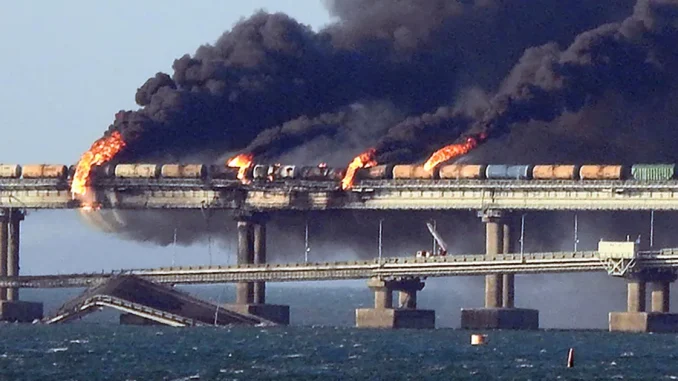
Ukraine has claimed responsibility for a significant blow to Russian logistics by damaging the Kerch Bridge—the vital structure linking Russia to the occupied Crimean Peninsula—through a carefully orchestrated underwater explosion. This marks the third major strike on the bridge since the start of the full-scale invasion in 2022.
According to Ukrainian authorities, the operation was executed by the country’s Security Service (SBU). In a statement released Tuesday, the agency reported that its operatives planted underwater explosives at the base of the bridge’s support structures. At precisely 4:44 a.m. local time, the charges were detonated, delivering what officials described as “severe” structural damage.
The explosives used reportedly weighed around 1,100 kilograms and were placed strategically on the bridge’s underwater pillars. The SBU emphasized that the complex operation had been months in the making, reflecting a long-term strategy to disrupt Russia’s war logistics.
Disrupting a Symbol and Supply Line
The Kerch Bridge, also known as the Crimean Bridge, serves dual functions: it facilitates both road and rail traffic between Russia and Crimea, and it holds deep symbolic significance for the Kremlin. Russian President Vladimir Putin personally inaugurated the structure in 2018, four years after Russia annexed Crimea. The project, which cost an estimated $3.7 billion, is a point of national pride for the Russian government and a key logistical route for military operations in southern Ukraine.
Traffic on the bridge was suspended twice on Tuesday—first in the morning, then again in the afternoon—before eventually reopening later in the day. While the full extent of the damage remains unclear, the attack is being seen as part of Ukraine’s broader strategy to target Russian infrastructure that supports its military.
Ukrainian officials stressed that the bridge remains a legitimate target, citing its use as a primary supply route for Russian troops stationed in occupied areas of Ukraine. The head of the SBU, Vasyl Malyuk, noted that previous strikes on the bridge took place in 2022 and 2023. This latest action continues that pattern—albeit with a new underwater tactic designed to catch Russian defenses off guard.
“We don’t repeat tactics,” Malyuk stated. “This time, we took our operation below the surface. The bridge represents a critical artery for Russian supply chains, and it must be disrupted.”
Broader Military Escalation
The bridge attack follows another daring Ukrainian operation just days earlier, when drones targeted Russian long-range bomber aircraft stationed deep within Russian territory. That incident reportedly caused billions of dollars in damage and disabled nearly one-third of Russia’s strategic cruise missile carriers, which have been used in multiple attacks on Ukrainian cities.
Following the bridge explosion, Russian authorities also suspended maritime traffic near Sevastopol—the largest city in Crimea and a major Russian naval base. Although restoration efforts began swiftly, the repeated targeting of the bridge signals Ukraine’s commitment to crippling Moscow’s war infrastructure.
As the conflict continues, Ukraine’s message is clear: key Russian assets, no matter how deeply protected or symbolically important, remain within reach.
Leave a Reply